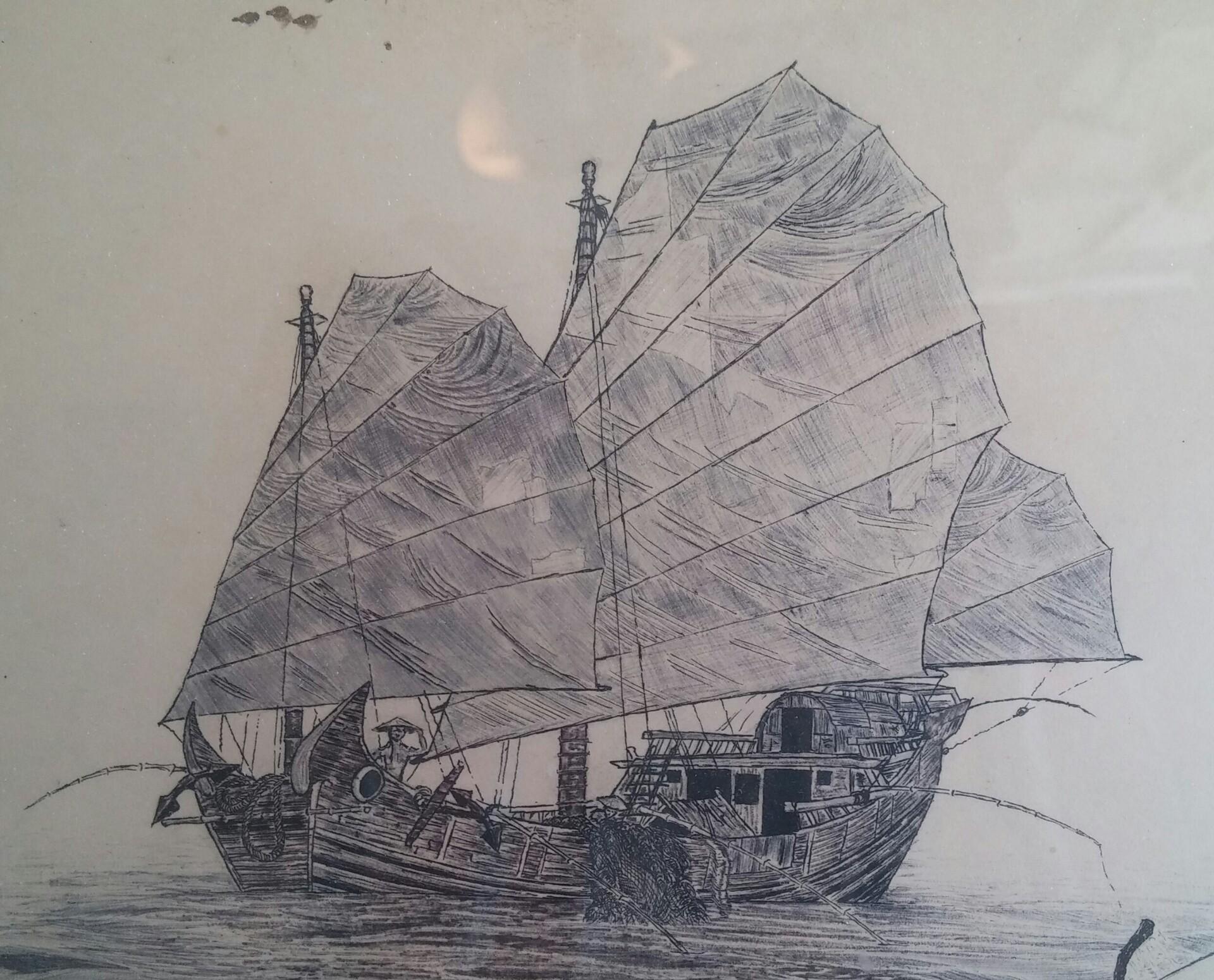
Closeup of Chinese Fishing Junk
ETYMOLOGY: The origin of the word "junk" in the English language can be traced to the Portuguese word junco, which is rendered from the Arabic word j-n-k (جنك). ... The word was used to denote both the Javanese/Malay ship (jong or djong) and the Chinese ship (chuán), even though the two were markedly different vessels. A junk is a type of Chinese sailing ship with fully battened sails.
MEDIA: This Chinese circa 1835 fishing junk was rendered strictly with Bic ball point pens and hard lined and shaded with India ink. The gentle seawater surges and wave motion textures were rendered with several Bic ballpoint sessions.
MY TWO MODELS: 钓鱼垃圾 == Chinese fishermen's "Diàoyú lèsè" fishing junks along with the anatomically perfect and precise bull Physeter macrocephalus sperm whale.
LOCATION: I rendered this image at the dining room table at my parents' home in Monarch Bay Terrace in Monarch Beach, California.
PROJECT: This sketch is a close-up of the boat used in my mini-poster which sold around the world and was rendered as part of my 1986-ish ""Hakugei: The Legend of the Great White Whale:" which is based upon American classic literary author Herman Melville's " Moby Dick: or The Whale," my illustrations for which were being submitted to Ohka (“cherry blossom”) Publications via Books Nippon's distributor on Sixth Street in Downtown Los Angeles and published as a coffee table book in Japan.
This is a closeup of my 1986 ball point pen and India ink illustration of a junk in the South China Sea circa 1820. Not shown is the spine and hump of the great embattled albino sperm whale, Moby Dick.
This was one of two Moby Dick mini posters included on a ten thousand sheet run of my eight-color Argonaut Anthologies Multimedia poster made courtesy of then-Executive Vice President Larry Lemming at Gore Graphics in the Silverlake District of Los Angeles back in 1986. I wonder what became of Larry?
Famous for its long history of printing major motion picture posters and high-end gallery-quality limited editions, Gore took a dirt nap in the 2000s as did it's sister in New York. It was either the recession of 2006 or the Great Recession of 2008 that killed Gore and her sister, Action Graphics in New York City.
THE BOOK: "Hakugei: The Legend of the Great White Whale" was an edited and assembled anthology of rendered art based on Herman Melville's 1851 novel Moby Dick. The Tokyo publishing house assembled this coffee-table sized book from a number of illustrations focused upon both classic American "Charles W. Morgan" class American whaling ships and renders of the Great White Whale.
JUNK CONSTRUCTION: There are two types of junk in China: Northern junk, which developed from Chinese river boats, and southern junk, which developed from Austronesian ship designs, which have been trading throughout Asia, Indochina, India, Micronesia, Indonesia, the Philippines, Malaysia and Japan since prehistoric times and in more modern times they traded with the Eastern Han dynasty since the 2nd century AD. They continued to evolve in later dynasties, and were predominantly used by Chinese traders throughout Southeast Asia. They were found, and in lesser numbers are still found, throughout Southeast Asia and India, but primarily in China.
Chinese junks referred to many types of coastal or river ships. They were usually cargo ships, pleasure boats, or houseboats. Historically they have ranged in size from small river and coastal vessels to large ocean going ships, and there are significant regional variations in the type of rig, however they all employ fully battened sails.
The sail of Chinese junks is an adoption of the Malay junk sail, which used vegetable matting attached to bamboo battens, a practice originated from Indonesia. The full-length battens keep the sail flatter than ideal in all wind conditions. Consequently, their ability to sail close to the wind is poorer than other fore-and-aft rigs.
The historian Herbert Warington Smyth considered the junk as one of the most efficient ship designs, stating that "As an engine for carrying man and his commerce upon the high and stormy seas as well as on the vast inland waterways, it is doubtful if any class of vessel… is more suited or better adapted to its purpose than the Chinese or Indian junk, and it is certain that for flatness of sail and handiness, the Chinese rig is unsurpassed."
The word "junk" in the English language can be traced to the Portuguese word junco, which is rendered from the Arabic word j-n-k (جنك). ... The word was used to denote both the Javanese/Malay ship (jong or djong) and the Chinese ship (chuán).